Masters Compare - Find your perfect masters course.




Masters Compare - Find your perfect masters course.
 Study Details: MSc 1 year full-time
Biomedical Engineering is the application of engineering principles to medicine, biology and healthcare.
Our course covers the development of methodologies and devices, applied to topics in healthcare technology and in advancing the state-of-the-art in the field. Core modules cover the fundamentals of biomedical engineering including biomedical imaging, biomechanics, medical devices and systems modelling. Optional modules allow you to specialise in an area of interest, for example signal processing, systems modelling or computational intelligence.
You will also undertake an individual research project – an extensive experimental, theoretical, or computational study on a topic of your choice, guided by a research active academic supervisor. Previous project titles include: Development of a bicycle adapter for a finger amputee; Monitoring psychological stress and mental health status using biological signals; PKPD modelling to assess the effects of anti-cancer agents on tumour volume; 3D morphable face model for emotion recognition; A wearable device for monitoring blood pressure.
A minimum 2:1 undergraduate UK honours degree or equivalent international qualification, in an engineering, physical sciences or mathematical subject.
Please note that applicants will need post A2 Level (or equivalent) knowledge in Mathematics, covering topics such as linear algebra, calculus and analysis, and including differential equations. This could be gained through a mathematics module taken as part of an undergraduate course. It is expected that candidates have a good understanding of these topics at the start of their MSc studies.
Nurture your skills to develop your career and become part of the change you want to see with our Careers Support.
For modules details please see website
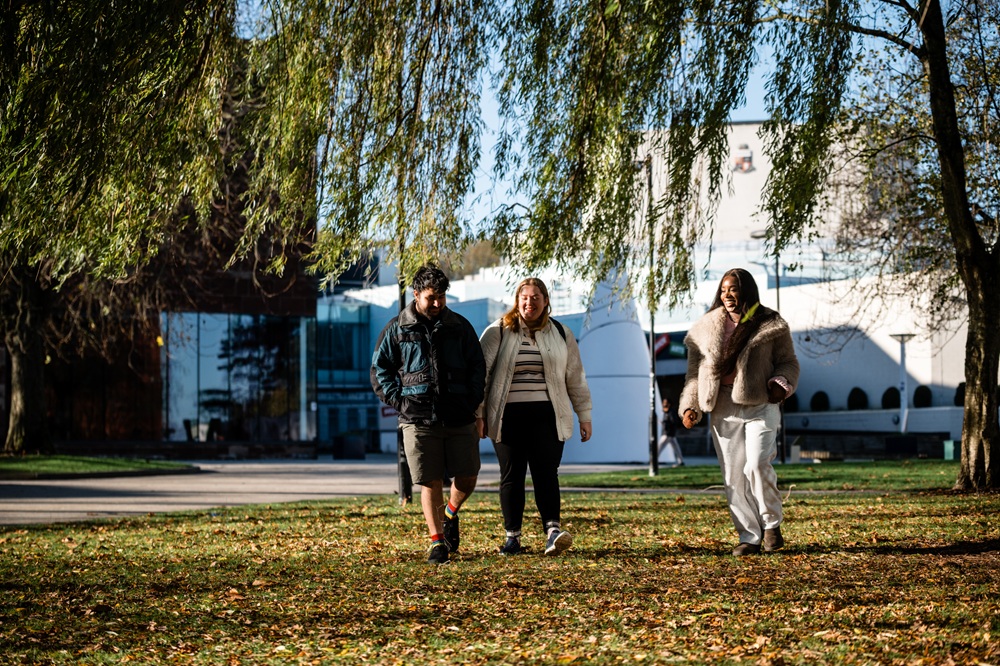
University information Founded in 1965, the University of Warwick is ranked 74th in the QS World University Guide 2026, is the youngest member o...