Masters Compare - Find your perfect masters course.




Masters Compare - Find your perfect masters course.

 Study Details: Full time 1 year
Drive the future of AI with advanced statistical and machine learning expertise. Through our ultra-modern curriculum, the MSc in Statistics and Artificial Intelligence will empower you to go beyond off-the-shelf AI tools. You’ll gain a deep understanding of the powerful statistical techniques underpinning modern AI, enabling you to apply and modify these models for real-world challenges.
Lancaster University’s School of Mathematical Sciences is at the forefront of mathematical AI research, which means you will learn from leaders in this field. We have recently been awarded major grants of £12 million and £9 million relating to AI and machine learning to establish the Mathematics for AI and Real-World Systems (MARS) group and lead the Probabilistic AI Hub.
Where other AI and data science master’s focus on computing and engineering elements, we bring a new perspective by teaching the statistical foundations behind AI models and machine learning. So, if you have a strong maths background and are interested in being at the forefront of AI technology, the MSc Statistics and Artificial Intelligence is for you.
The advanced level of skills and knowledge that you gain throughout the MSc will make you highly sought after by employers:
There are three phases to your learning. You will first strengthen your core knowledge and skills in statistical methods and inference. Topics covered are frequentist and Bayesian inference, data analysis, generalised linear models, statistical computing and communication. These topics provide the foundations on which to build an understanding of the mechanics of AI and machine learning.
In the second phase, you will delve deeper, taking advanced modules in supervised and unsupervised learning, deep learning and statistical models for complex processes. As well as learning the statistical and computational ideas used to infer structure in these models, you will gain practical insight by applying them to data.
In phase three, you will complete an independent research project on a topic of your choice, supervised by experts from our School of Mathematical Sciences. You might choose to progress your understanding of a topic covered in a module, investigate a topic not covered by one of the modules or undertake an extended data analysis.
Upon graduation, you will be equipped to lead in the development and application of AI technologies across a range of industries.
2:2 Hons degree (UK or equivalent) in Mathematics or Statistics.
We may also consider non-standard applications where you have studied a degree in other quantitative subjects that include courses in probability, statistics, linear algebra, and calculus.
You should clearly be able to demonstrate how your skills have prepared you for relevant discussions and assessments during postgraduate study.
For fees & funding options, please visit our website for more.
On completion of the MSc Statistics and Artificial Intelligence, you will possess skills and knowledge in high demand from employers. This will open you up to a career in a range of industries, addressing a need to not only apply but potentially modify machine learning/artificial intelligence-related models. You will also be a great candidate for data science roles.
The starting salary for many graduate statistical roles is highly competitive, and popular career options include:
Strong graduates will also be highly competitive for PhD positions, at Lancaster and other institutions.
Core
Advanced Statistical Modelling
Computing and Algorithms for Statistics
Deep Learning
Estimation and Inference
Hidden-Process Models
Machine Learning
Statistics Dissertation
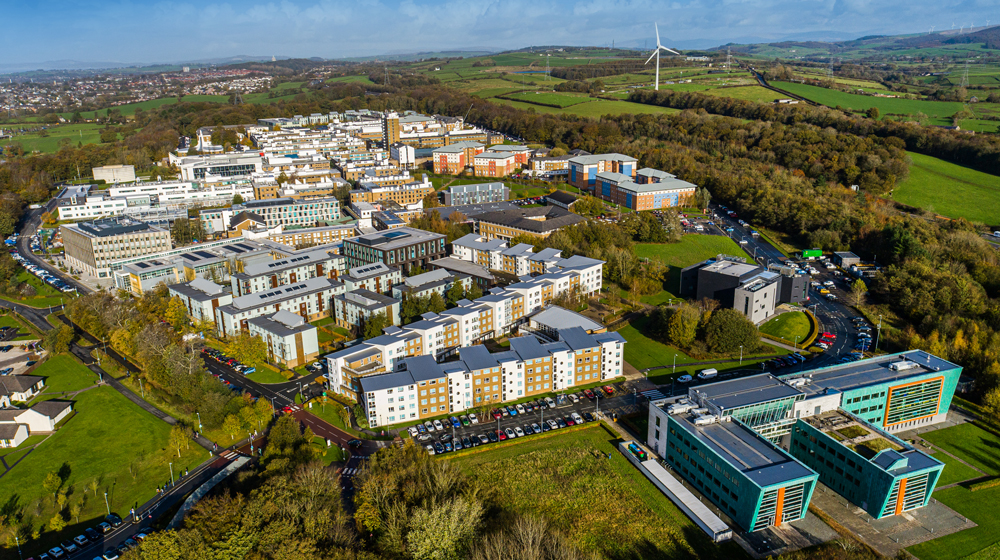
Global reputation and research excellence Lancaster is a top 10 UK university (Complete University Guide 2026) set on a 578‑acre parkland campus in n...

 Sat 17 Oct 2026