Masters Compare - Find your perfect masters course.




Masters Compare - Find your perfect masters course.
 London, All England
Study at one of the world’s top-ranked universities, working with researchers who are leading in their fields, including research in cosmology, quantum science, astrophysics & space technology.
The Department of Physics and Astronomy at UCL is among the top departments in the UK for this subject area, currently ranked 4th nationally in the QS World University Rankings 2026 for Physics & Astronomy.
Our graduate students benefit from a vibrant research community, bringing together world-renowned researchers and academic staff to inform our graduate teaching. Our large number of international collaborations provide opportunities to work with an international team, including at the Large Hadron Collider (LHC) in Geneva and at the EISCAT radar instruments in Scandinavia for studying the Earth's upper atmosphere.
Our programmes:
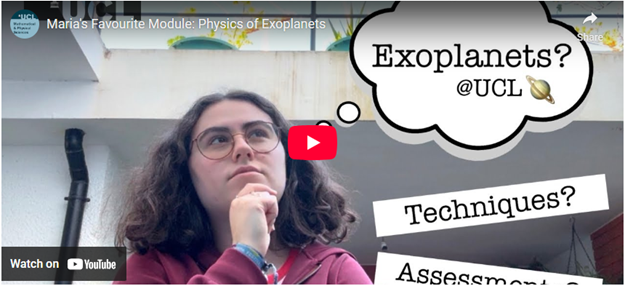
UCL Physics and Astronomy graduate student Maria talks about her favourite module on the physics of exoplanets! Find out about the methods used to detect exoplanets, and what information can be explored through using these techniques.
Sign up and keep up-to-date with the latest info about our courses, open events, scholarships and more.
UK, EU, and International applicants

Masters study opportunities at UCL Make your Master’s matter For a real-world advantage, study at a world-class university and your Master’s wi...